
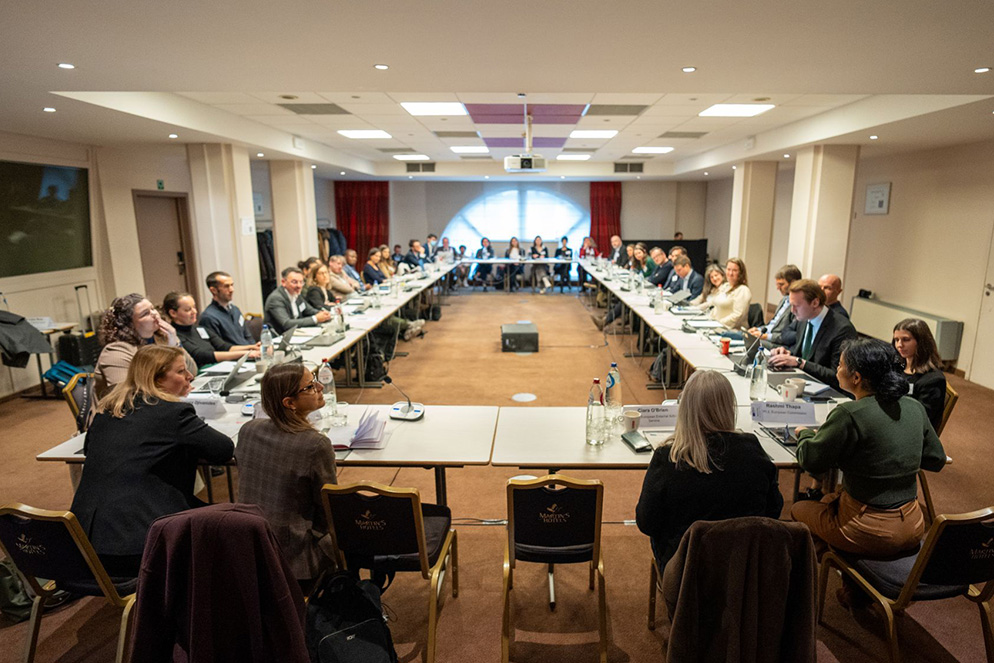
Photo credit: Patrick Doodt | Doodt Media GmbH
BY NATHAN COYLE / ON 1 APRIL, 2026
On 29 January 2026, Nathan Coyle joined EU institutions and civil society organisations in Brussels for a Funding Instruments Meeting under the Civil Society Dialogue Network (CSDN), hosted by the European Peacebuilding Liaison Office. The focus of the meeting was straightforward but important: how EU funding and emerging technologies can better support conflict prevention and peacebuilding in practice.
Bringing together practitioners, policymakers, and organisations working directly in conflict-affected contexts, the discussion offered a useful snapshot of where technology sits within peacebuilding today. What became immediately clear is that this is no longer a future-facing conversation. Across different contexts, peacebuilders are already using digital tools as part of their everyday work, from analysing conflict dynamics online to running consultations at scale and supporting early warning and response mechanisms. The question is not whether technology has a role to play, but how it is being used and who it is serving.
Much of the discussion centred on participation. Digital tools are making it possible to engage communities that would otherwise be excluded from traditional peace processes, whether due to geography, security constraints, or political barriers. Platforms that allow people to contribute asynchronously, often through familiar tools like messaging apps, are opening up new forms of dialogue. This shift matters. It has the potential to reshape who gets to be part of peacebuilding processes and how those processes are designed. At the same time, there was a clear recognition that scale does not automatically mean meaningful engagement. Expanding participation without addressing how contributions are interpreted, used, and fed back into decision-making risks becoming extractive rather than inclusive.
Alongside these opportunities, a set of recurring concerns came up across the room. Questions of data governance, digital security, and ethical design were not abstract issues but practical challenges faced by organisations working in complex environments. There was a shared awareness that technology is not neutral. The tools being used, and the systems behind them, often reflect external priorities, assumptions, and power structures. Without careful attention, they can reinforce the very inequalities that peacebuilding efforts are trying to address. This is particularly visible in the way data is collected, analysed, and owned. Who controls peacebuilding data, and who benefits from it, remains an open question in many contexts.
Another point that surfaced repeatedly was the gap between innovation and funding structures. While organisations are experimenting with new approaches, the frameworks that support this work have not fully adapted. Short-term project cycles, rigid funding requirements, and limited space for iteration make it difficult to develop and refine approaches over time. Building responsible, context-sensitive uses of technology requires flexibility and continuity, neither of which fit easily into traditional funding models. If technology is to play a more effective role in conflict prevention, this disconnect will need to be addressed.
At the same time, there is a clear opportunity for the European Union to play a more defined role in shaping how technology is integrated into peacebuilding. The EU’s emphasis on human rights, ethical governance, and multilateral cooperation provides a strong foundation, but the challenge lies in translating these principles into practice. Supporting locally driven approaches, ensuring data sovereignty, and grounding technological interventions in the realities of specific contexts are all part of that process. This is not simply about introducing new tools, but about rethinking how peacebuilding systems are designed and supported.
What stood out from the meeting was not a single solution or approach, but the value of the exchange itself. Bringing together those working on policy, funding, and implementation created a space where assumptions could be challenged and experiences shared more openly. Too often, discussions around technology happen separately from the realities of peacebuilding practice. Conversations like this help to close that gap, even if only partially.
For the PeaceTech Alliance, this reinforces the importance of continuing to build connections across these different communities. The development of PeaceTech is not just a technical process, but a collective one. It requires input from practitioners, researchers, policymakers, and the communities directly affected by conflict. Without that, there is a risk that the field becomes driven by tools rather than needs.
The discussions in Brussels made it clear that PeaceTech is already taking shape, but not yet in a fully coherent or coordinated way. There is momentum, but also fragmentation. Moving forward will require more than isolated projects or pilot initiatives. It will require a shared effort to ensure that technology is developed and used in ways that are ethical, inclusive, and grounded in practice.
That work is still ongoing - Thank you to the European Peacebuilding Liaison Office (EPLO) for inviting us and for hosting such an engaging and insightful event. To learn more about EPLO and its work, visit www.eplo.org.