
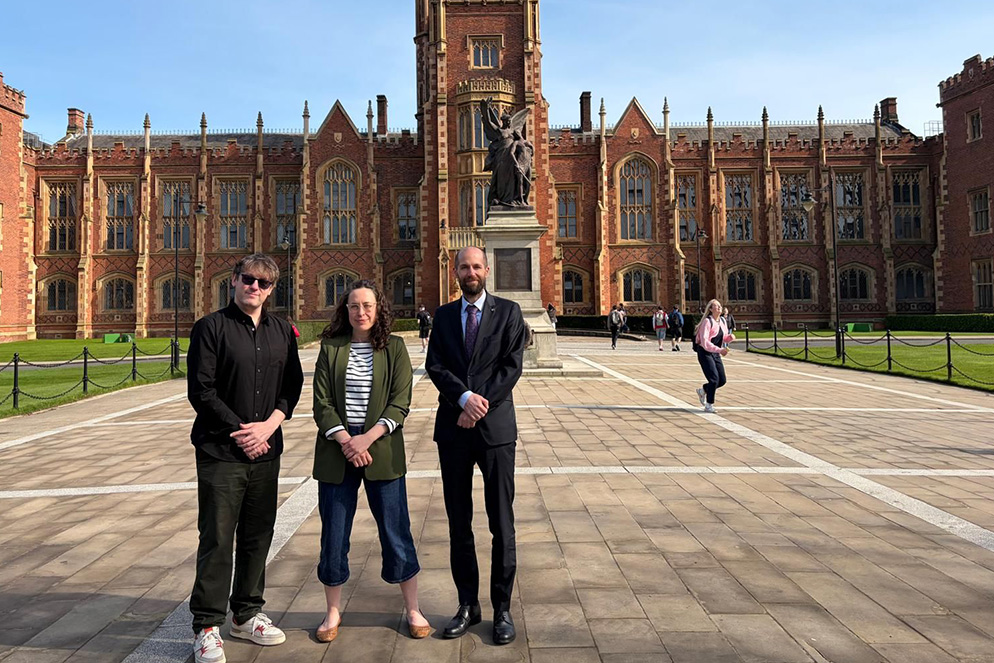
Pictured: Nathan Coyle (AIT), Louise Mallinder (Queen’s University Belfast) and Daniel Hikes-Wurm (BMLV)
BY NATHAN COYLE / ON 1 APRIL, 2026
In March, the PeaceTech Alliance engaged across Great Britain and Ireland, contributing to ongoing conversations on how technology is shaping conflict, risk, and peacebuilding in practice.
The first of these took place in London, where we participated in a closed-door, multi-stakeholder workshop on technology and mass atrocity risks, co-organised by Search for Common Ground and the UK Foreign, Commonwealth and Development Office. The discussion brought together actors from government, civil society, and the technology sector to reflect on emerging trends, from AI and encrypted communication to new platforms and shifting patterns of online behaviour in high-risk contexts.
While the format was deliberately confidential to allow for open exchange, the overall direction of the conversation was clear. Technology is increasingly shaping how risks emerge and evolve, but responses remain fragmented. Across sectors, there is a growing need for better coordination, shared understanding, and more grounded approaches to how digital tools are designed and used in fragile contexts.
Within this, the PeaceTech Alliance contributed reflections from its work in Austria, particularly around human-centric design, participatory approaches, and the importance of data governance and responsible data sharing. A key point raised was that if technology is to support peacebuilding, it must be rooted in the realities of those it is intended to serve, not just in the capabilities of the tools themselves.
Following London, the conversation continued in Belfast, where together with Daniel Hikes-Wurm from the Austrian Ministry of Defence, we co-hosted a session with Queen’s University Belfast titled “PeaceTech: Setting the Scene for a Potential PeaceTech Context for Great Britain and Ireland.”
Belfast is a particularly interesting place to have this conversation. As a city shaped by decades of conflict, the legacy of the Troubles is still visible, not only in physical space but in social and political dynamics. Peace here has been built over time through complex, often fragile processes of dialogue, trust-building, and community engagement. This creates a very different starting point for thinking about PeaceTech.
The discussion reflected that context. There was a wide range of perspectives, many of which challenged how PeaceTech is often framed elsewhere. In Belfast, there is a strong awareness that peacebuilding is not something that can be engineered through tools alone. Technology may support processes, but it does not replace the relationships that underpin them.
At the same time, there was clear interest in how digital approaches might contribute. In particular, participants explored how technology could support broader participation, especially in engaging communities that are not always part of formal processes. However, this was consistently balanced with caution. Expanding participation through digital means raises questions about depth, trust, and ownership, particularly in contexts where these issues remain sensitive.
What emerged from Belfast was not a rejection of PeaceTech, but a reframing of it. Rather than starting from the technology, the conversation started from the context, asking what role, if any, technology should play within existing peacebuilding practices. This shift in perspective is important, and it is one that will likely shape how PeaceTech evolves in regions with strong peacebuilding traditions.
Across both engagements, a common thread was the need to move beyond isolated tools and towards more coherent, context-aware approaches. Technology is already part of the landscape of conflict and peacebuilding, but how it is integrated, governed, and understood is still developing.
For the PeaceTech Alliance, these conversations reinforce the importance of dialogue across different contexts. PeaceTech cannot be defined in a single place or exported as a fixed model. It needs to be shaped through engagement with those working directly in different environments, each with their own histories, challenges, and perspectives.
A big thank you to everyone who contributed to these discussions, and to the partners who hosted and facilitated them. These exchanges are essential. Not because they provide immediate answers, but because they help surface the right questions.
That is where this work continues.